
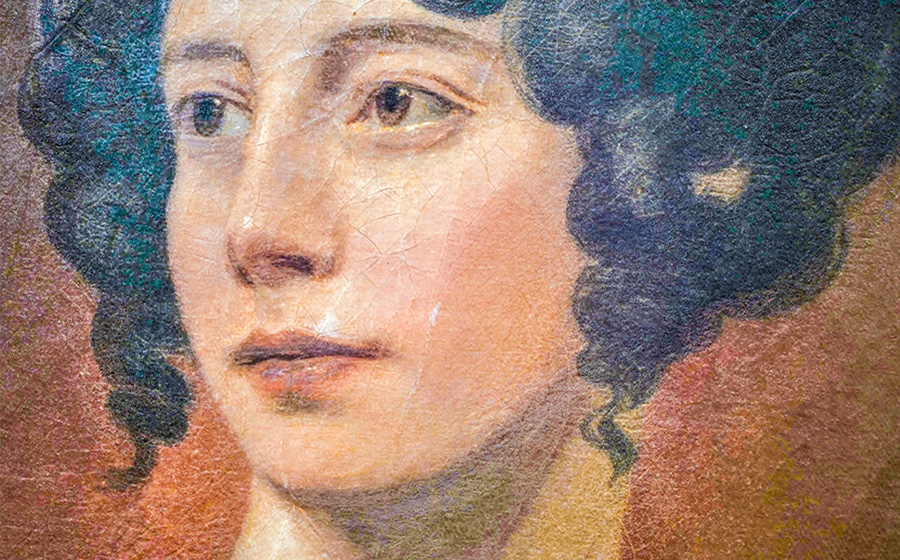
Born in Brazil - buried in Talbot Village
Thomas Palmerias Hawkins
Thomas Palmerias Hawkins was born at Palmerias, Brazil, on 8 August 1875.
His parents had emigrated from Pimperne, Dorset, in 1874 with their four children. They sailed to Brazil on the SS Moselle, of the Royal Steam Packet Co.
Thomas’s parents, Robert Whittle Hawkins of Wareham and Sarah Fanny Ford of Pimperne, married on 16 October 1864. They brought up their young family in Pimperne. Two of their six children died young. It was with the other four children, Harriet Anne, George William, Charles Robert and James, that they ventured to Brazil. Unfortunately James, aged one, died on the outward journey and was buried at sea on 12 May 1874.
After their arrival, another son was born: Thomas Palmerias Hawkins. Palmerias was the name of the place where they had settled in Brazil. Like many of the other Brazil emigrants, it was not long before the family returned to England.
On their return, the family did not go back to Pimperne, but decided to settle in Kinson Road in Wallisdown, where they had five more children. The family attended St Mark’s Church and the children attended the village school.
Talbot Village Archivist Carol Medlicott surmises that the sea journey home must have been an adventure for the boys, as it inspired two sons, George William and Thomas Palmerias, to join the Royal Navy on their 18th birthdays.
George William joined the Royal Navy on 31 August 1886. He married Alice Maria Budden at Longfleet on 29 July 1899 and they settled in Portsmouth to raise six children. George William rose through the ranks, retiring in 1922 as a Lieutenant Commander after serving in World War I.
The younger brother, Thomas Palmerias, joined the Royal Navy on 8 August 1893 and retired in 1919, having served as a Petty Officer during World War I. Thomas Palmerias married Edith Whitely in Worcester in 1922, but she died in 1923. He then married Lilian May King in Colchester in 1925. They settled in Canford Road in Wallisdown but had no family. Thomas was buried in St Mark’s churchyard in 1935 and Lilian in 1961.
Acknowledgment for this first section is to the Talbot Village Archivist, Carol Medlicott. Her article in St Mark’s News, “From the Archives”, December 2013, is the source for this section. The full article contains considerably more information.
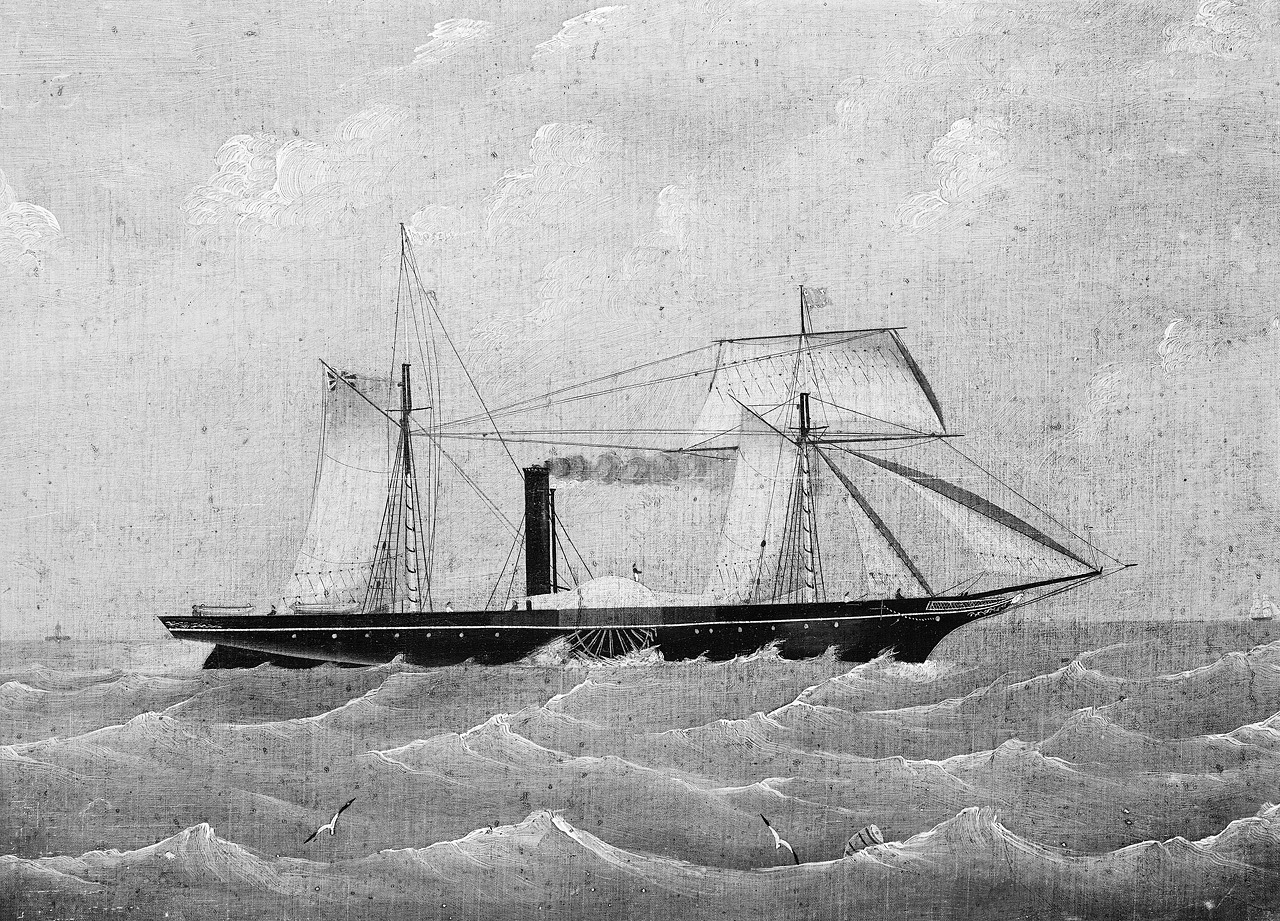
© National Maritime Museum, Greenwich, London.
The Moselle was built in 1852 by Ditchburn & Mare at West Ham for the General Steam Navigation Company (GSNC). The engines were built and fitted by the GSNC themselves at their yard at Deptford.
What was the background to the family emigrating to Brazil?
Intrigued by the Brazilian connection, I wondered: “Why Brazil?”
Interestingly, I came across what I believe to be the answer when reading Tess of the D’Urbervilles by Thomas Hardy.
Hardy’s first mention of Brazil in the novel is found in Chapter XXXIX, paragraph 7. Regarding Angel Clare, who was in love with Tess, Hardy writes:
“In going hither and thither he observed in the outskirts of a small town a red-and-blue placard setting forth the great advantages of the Empire of Brazil as a field for the emigrating agriculturist. Land was offered there on exceptionally advantageous terms. Brazil somewhat attracted him as a new idea. Tess could eventually join him there . . .”
Next, in Chapter XL:
“At breakfast Brazil was the topic, and all endeavoured to take a hopeful view of Clare’s proposed experiment with that country’s soil, notwithstanding the discouraging reports of some farm-labourers who had emigrated thither and returned home within the twelve months.”
Brazil was not the hoped-for Utopia.
In Chapter XLI, paragraph 11, Hardy writes:
“At this moment he was lying ill of fever in the clay lands near Curitiba in Brazil, having been drenched with thunder-storms and persecuted by other hardships, in common with all the English farmers and farm-labourers who, just at this time, were deluded into going thither by the promises of the Brazilian Government, and by the baseless assumption that those frames which, ploughing and sowing on English uplands, had resisted all the weathers to whose moods they had been born, could resist equally well all the weathers by which they were surprised on Brazilian plains.”
In Chapter XLIX, paragraphs 6, 7 and 8, Hardy writes:
“The eyes for which Tess’s letter was intended were gazing at this time on a limitless expanse of country from the back of a mule which was bearing him from the interior of the South-American Continent towards the coast. His experiences of this strange land had been sad. The severe illness from which he had suffered shortly after his arrival had never wholly left him, and he had by degrees almost decided to relinquish his hope of farming here, though, as long as the bare possibility existed of his remaining, he kept this change of view a secret from his parents.
The crowds of agricultural labourers who had come out to the country in his wake, dazzled by representations of easy independence, had suffered, died, and wasted away. He would see mothers from English farms trudging along with their infants in their arms, when the child would be stricken with fever and would die; the mother would pause to dig a hole in the loose earth with her bare hands, would bury the babe therein with the same natural grave-tools, shed one tear, and again trudge on. Angel’s original intention had not been emigration to Brazil, but a northern or eastern farm in his own country. He had come to this place in a fit of desperation, the ‘Brazil movement’ among the English agriculturists having by chance coincided with his desire to escape from his past existence.”
Clearly, my source for this second section is Thomas Hardy’s novel Tess of the D’Urbervilles.
How interesting it is that the question “Why Brazil?” has led to this intriguing piece of social history.
Written by Christopher Thomas
Descendant of Charles Robert Hawkins, one of the brothers who returned, as a boy, from Brazil to Wallisdown and Talbot Village.
April 2026